An essay by Krystel Reina
No Time
Spoilers for the third-season finale of Strange New Worlds.
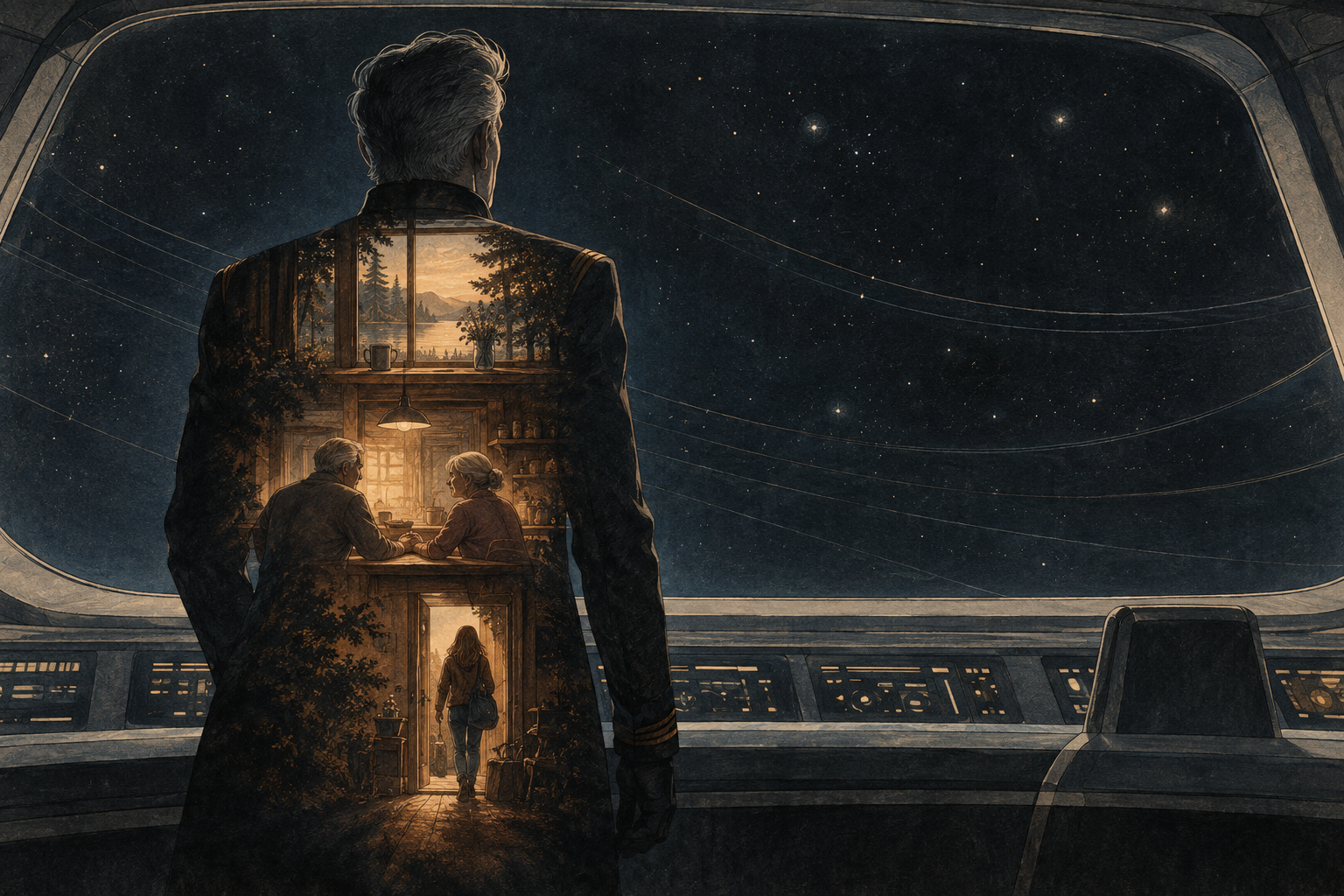
Captain Christopher Pike has known for years exactly how his story ends. The show I finished this month is three seasons of him giving orders anyway. I watched it faster than I have watched anything, and when it was over I wrote to a former IT director, on my lunch hour, that I had cried like a baby, and asked whether he'd be in the office Tuesday.
The finale gifts Marie and Pike a life together, and everyone watching knows precisely where (and when!) that life isn't. There is a knock at a door and it is not what we were led to think. Then a cozy cabin, an anniversary gift that feels tactile, an apron with his name on it, a sudden daughter, the daughter leaving home, an old woman in a bed with her happiness worn into the lines of her face as she smiles at the man she has loved her whole life. The orchestra swells and under it a song I know is barely perceptible until it just isn't, and the one lyric that surfaces, as a mantra, is no time.
The life between these lovers is unfolding in a place with no clock in it, but the clock is running anyway. Stay with me, she says, and the knock gets louder, and the desperate look between them will not go into words, and I am in the audience with everyone else, struggling to breathe.
I keep coming back to what it takes for her to surrender. She has agreed to stand guard over something ancient and evil, for good, forever, and the part of her that is still a woman cannot cross that line on principle. She has to be handed the life first. Not as payment; as a prerequisite. A universe in which she has never held the very thing she exists to protect cannot feed her. She cannot give up what she has never held, so the world gives it to her as memory, all of it, at light speed, and only then can she register the weight of it in order to let it go. How human, to need the one thing you do not have time to receive. And this is the woman who spent three whole seasons telling him his fate was not inevitable. Here, when she is handed hers, she takes it, and I still can't decide whether what crossed her face was understanding or transference. The life they are given is the one in which she was right about him. In it he takes the assignment, and he comes home with his face.
Captain Pike returns to his bridge alone, carrying the memory of a whole entire shared life that nobody else on the ship can see. The audience can feel the weight; we are still struggling to breathe. He says that maybe memory is as real as the present.
My former IT director no longer pays for streaming. He stopped, in part, when the newer shows introduced a drive that could take a ship anywhere in the universe instantly, because the universe had rules, there was a book, and someone had been careful for decades to follow it. He has the book. He keeps a server with every series and every film on it, in case I ever want to watch them all the right way. He has not seen the episode and he will not.
I came into the franchise through the door purists don't count, the reboots, later in life, and told him so with embarrassed in front of it. What I had fallen for, I told him, was a strangely romanticized version of what the Federation represents. I put lol after it.
What I had fallen for: a crew trained, and empowered, to disagree. Officers who bring the captain alternatives, out loud, at the console, in front of each other, and a Captain who carefully weighs the trade-offs and gives the order. It's so beautiful. I want to design one, I wrote, looool because I am me, and then, because I am also that person, I wrote how I knew that we don't have one.
The people who run the place do not have a shared, functional mental model of a persistent starship command bridge. I know it isn't there because the reasons our technologies exist are only now becoming visible to us, which makes us a very wealthy pre-warp society attempting warp with an engine it bought: no plotting, and no felt need for the plotting, because when the ship hits something and comes apart, they will simply build another ship and recruit another expertly trained enterprise crew. On the show, the ship is the disposable part. It has been destroyed more times than I can count and they build another with the same name and one more letter after the number, and the crew walks onto it. Here it is reversed. The ship keeps its name. The crew is the part that gets replaced.
That is the brute-force anti-pattern of massive organizations, and massive is the operative word. A thing with enough mass has gravity. Everything nearby falls toward it, and it does not feel the fall. Deep pockets absorb a catastrophe more reliably than planning correctly prevents one, so the planning quietly stops being anyone's focus. From far enough away it looks like resilience. Watching it from inside, while my team writes the contracts that are supposed to keep the platform from tearing itself apart at warp speed, is maddening. The enterprise just wants to punch it.
And the cost is not the crash. Crashes are loud and get budgets. On the ship there are two systems for surviving speed. The structural integrity field keeps the hull from tearing itself apart. The inertial dampeners keep the crew from being thrown into the back wall when the captain says go. My team writes the first. The second is not anyone's line item, and the cost of that is warp shear on the people still aboard, the ones trying to keep work moving while the system they depend on is being reconsidered and rebuilt around them, the ones in the buffer while the ship is busy building its replacement.
On the show, one man survived seventy-five years suspended in a transporter buffer and came out to find the ship he'd kept running had been replaced several times over and what he knew was obsolete, until it wasn't. That is the buffer. The people in it are not lost. They are held, at full pattern, while the organization builds its replacement. It is entirely possible to budget for the next system, or the next crew, without accounting for what happens to the people caught between this one and the next.
The people who hired me are gone. A reduction in force went through IT and left holes everywhere, and I used to navigate by their light. Light keeps arriving for a while after the star is gone.
My former leader was my skip-level when the enterprise hired me, in the before-times, one of the lights. He read the whole thing. He said it was a fascinating read, that I had pulled the franchise through all of that by absolute brute force, and that the metaphors were not wrong. He said the command bridge on the show is hierarchical as well as democratic, and that in some ways they do want it, just not the democratic part. He said that even if we had leaders who thought this way, we won't, because the system does not reward the people who do. I had used brute force for the anti-pattern. He used it for my metaphor. He brought the captain an alternative, out loud. I have not answered that part. We are having lunch Tuesday, but I will be wearing my Cartographer clothes.
His reply leaves a question the room cannot answer for itself. What if people can see the relationship, understand the consequence, and still have reasons to act as though they don't? A well-designed bridge does not remove the incentives governing whoever sits in the chair. I can give disagreement a place on a screen. That does not mean the ship will let it change the course. The design has to survive the bureaucracy too, and what comes out the other side is the intent and the feeling that sparked it, a little different, and sometimes unrecognizable by the next mission.
Pike, for the record, did the math. He knows how his story ends because he was shown it, and then shown a version where he avoided it, and in that version the cost moved to someone standing next to him on the bridge. So he kept it. One person absorbing the hit so the crew wouldn't have to. It is the anti-pattern run in reverse, and it is fiction, and I fell for it anyway.
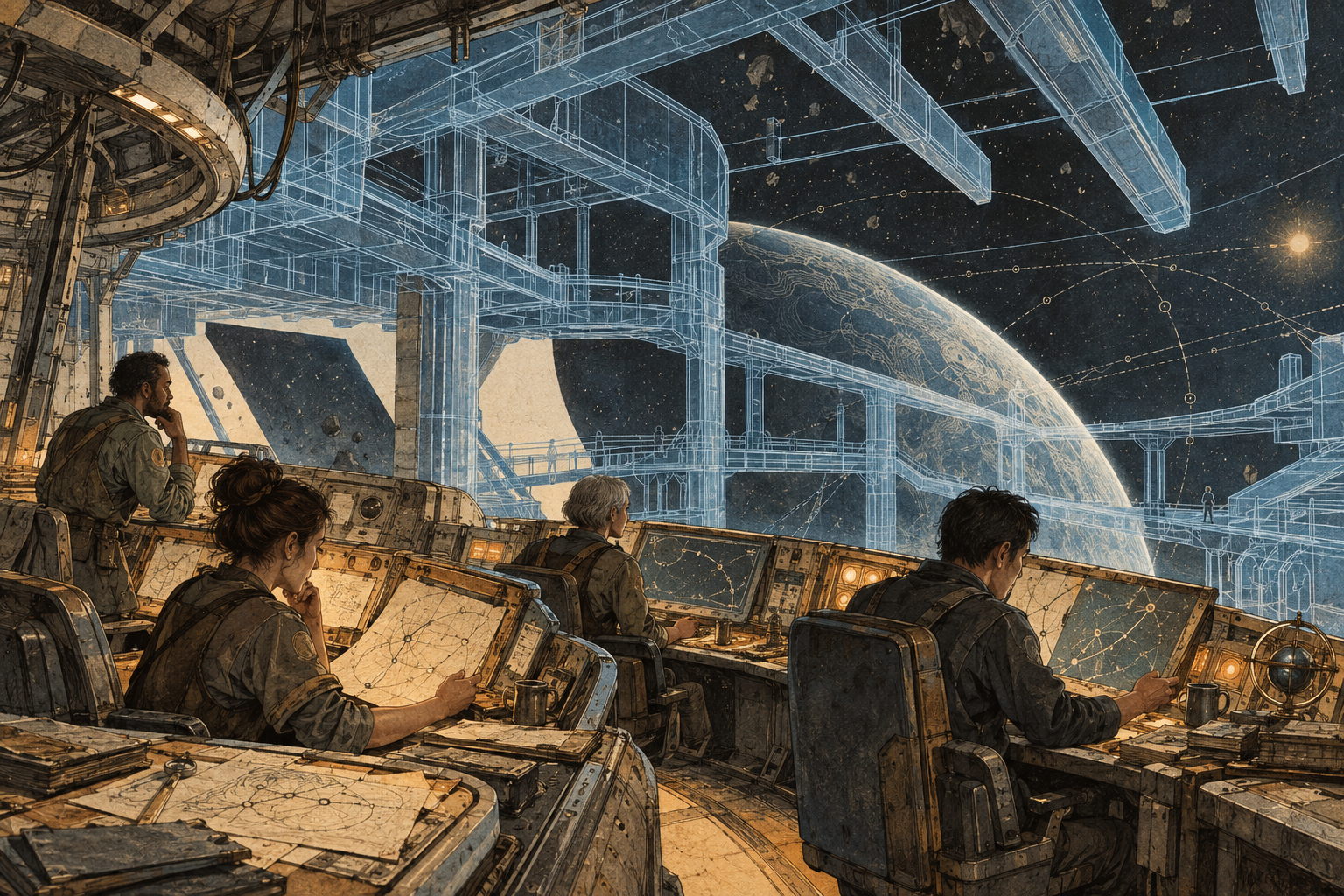
Ugly crying inside my Tesla later that evening, that song from the finale on repeat as loud as I could tolerate, here is what I did with the water leaking from my face. I took it to the Computer, and I asked it to sort the crew by what each of them says most often, so I could turn them into affordances for stations on a Bridge. Stations can be designed, intentionally, to house the precise controls a Starfleet crew of my dreams would need to perform at peak. Within days there was a working prototype, concept design by yours truly.
I imagined it differently at first. My team and me, standing in some ephemeral, non-existent simulation of a fictional place, massively decked out in perfect gear for maximum capability.
Command asks what we are trying to protect. Evidence asks what we actually know. Signals asks what changed, while attempting to translate what it might mean. Memory asks why it was built this way in the first place. Another station asks whose circumstances are missing from the picture, what has been treated as a general condition that is only true for some of the people involved. A shared picture can become very convincing while secretly making everyone in it more likely to agree, when the entire point of the simulation is disagreement.
Then maybe I was prototyping a game instead of a place: information arrives unevenly, no single station has enough data to decide alone, and the product, the thing being designed, is a record of how the decision was reached. The show has had that record since 1966. Every episode opens with the captain recording why: captain's log, stardate, here is what we are about to do and the reason. It is the least dramatic convention in the franchise, and no decision has ever left that bridge without its rationale attached. Then Shift Change. The next group inherits only what the first group leaves behind: the decision, its evidence, the assumptions someone remembered to record. Whatever seemed too obvious to write down becomes a problem for somebody else. And then the game outgrew the crisis, and what was left was a place you could leave unfinished work in and come back to, on an ordinary Tuesday with a half-formed question, and find that the question had kept going without needing to become an emergency first.
I have to be careful here, because the finale and the design do not fit together as neatly as I desire to make them.
Pike leaves the prison realm carrying a gravitational force that no single human should have to endure alone: a hole where a life had been, in the shape of a woman held and loved deeply. He carries himself as if the gaping wound were a scratch, the way he carries the scrapes and indignities of a battle. I say this perhaps too plainly: the ache and the grief are compressed into something easier for the people around him to digest. They sense that a thing has happened, the way large organizations are good at sensing and detecting gaps. What they cannot see is the mass. The happy habits and rituals of a newlywed couple, the mature parents saying goodbye to a grown daughter they raised together, all of it now a blank space that everything around him bends toward. You do not observe that kind of mass directly. You infer it from the orbits. It transmutes, in the seconds before he wakes up tomorrow, into something etched in him, if he consents to let it change who he becomes.
The rest of his crew did not witness any of this. The intimacy of the moment is devastatingly private. Simultaneously, on the bridge, Pike's body spasms as if a phaser has taken out his sternum, and his face holds a devastation anybody could mistake for a body reacting to painful stimulus. The ship's record could describe it in detail while missing every pointed detail that destroyed me that night. Someone standing in the room might perceive that a serious and damaging event has occurred. Watching him from outside the misty place where Marie was trying to say goodbye, we think: he's been hit. Can he breathe? Is he dying? Maybe he's dying. He is certainly clutching an invisible hole in his chest as if the only conclusion were his active unmaking.
Three versions of the same minute, then. The memory has the life. The body has the damage. The record has the event. Neither of the last two would give the crew the life they shared in the misty place. Just so, in my work, I can preserve the reason for a design decision, make an assumption visible, show where an account came from and when. I cannot make a record complete enough to render the totality of the price he paid. In what looked like seconds to any outside observer, his nervous system received an entire shared life, everything they were fighting for. I can't replicate that for posterity. Doing so would require something less like experience design and more like pure fiction. And describing Pike's last moments with Marie in words is its own form of betrayal, when you're me. The things that die here, the things that do not survive transfer: they are unacceptable. I refuse to sign my name on it. I have just spent three thousand words doing it anyway.
Marie's experience cannot become a requirement for everyone who needs to understand a consequence. We cannot hand people whole lives every time something important needs to cross a room, a threshold, a handoff, or a record. Maybe the shared picture has to carry some mark of what it cannot contain: an account from someone whose circumstances differ, a disagreement that has not been resolved, a question still attached to the reason and the person who asked it, rather than absorbed into a smooth answer everyone appears to share.
When I tried to write the finale down for the first time, I wanted to sob again just recalling it in an info dump. An info dump. The knock, the lifetime, the song I could barely hear rising as no time comes around again, and the embodied grief of a sacrifice, arriving as a message someone else has to read to understand. I yearn for a language that could get past the limitations of letterforms. To be precise: I'm human, therefore I cannot mind meld. The show can. In the same finale, two officers press their fingers to each other's faces and for a minute know what the other knows, so that two ships can fire as one, and it is treated as ordinary. Meanwhile a man on his own bridge carries a whole life nobody can be handed. The lossless crossing and the untransferable one, in the same hour of television. I want, perhaps need, that crossing to be less lossy. If I could design it, it would be lossless. I want the person on the other side to be able to say what arrived, with an embodied certainty our current technology cannot provide. Yet.
There is a file that goes with the design, for the real moments the room exists for, where one person knew a thing and another knew the other thing and nobody could see it whole. When I set it up I asked to be reminded to fill it, and then I didn't, and I could not have told you why in any way that felt acceptable to the parts of me that were sobbing that night. The first entry went in tonight. It is about the people I navigated by, and one of them is having lunch with me on Tuesday, and he has not read it.