An essay by Krystel Reina
The House I Didn’t Know I Was Living In
Before the Backrooms, there was the House of Leaves.
For most of my life, I believed I was moving freely through the world. Making choices. Forming opinions. Becoming myself. Fiercely me.
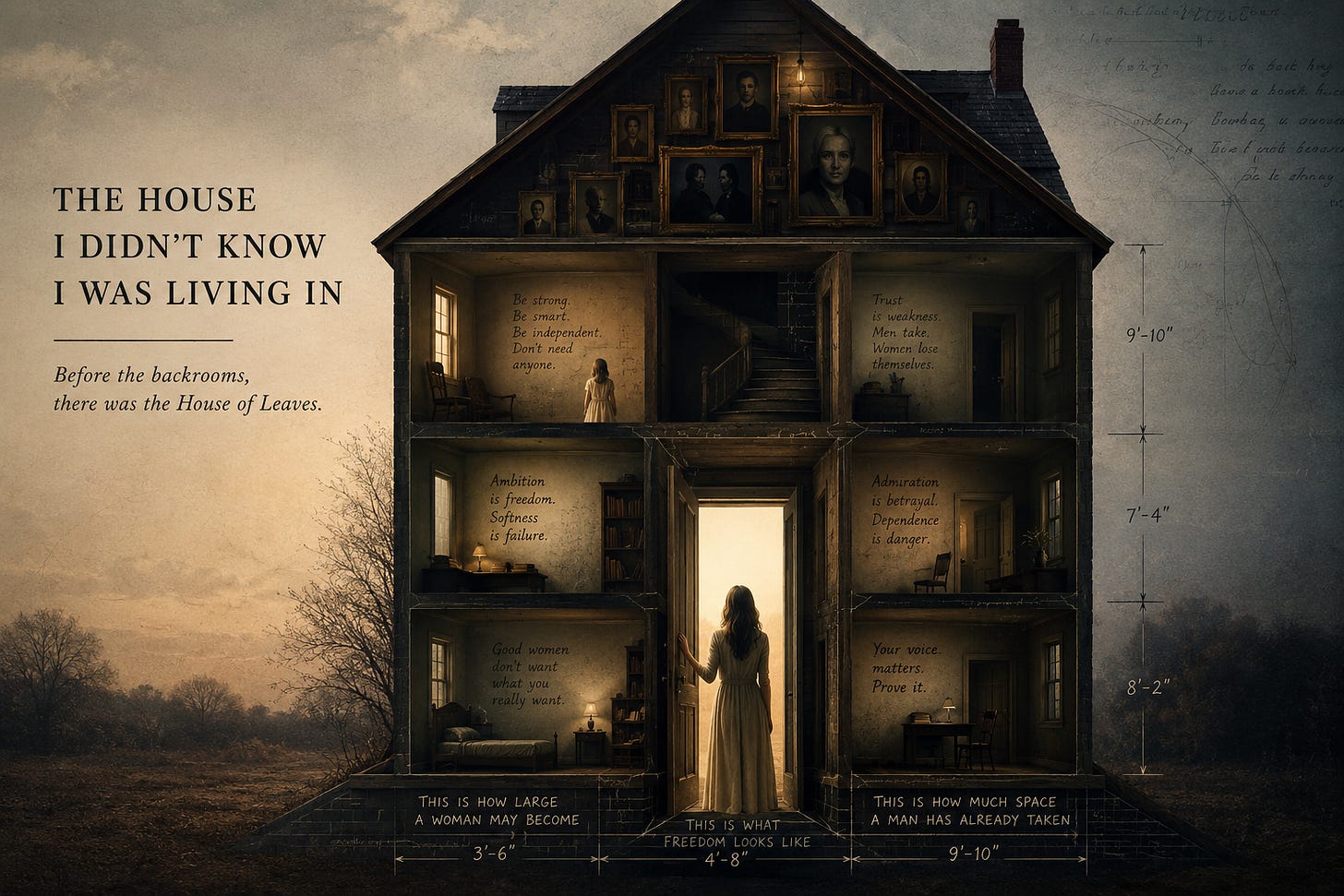
I did not understand that I was walking through a house. Not an identity: a space in time with tiny, archaic scribbles— some glyphs. Some in silly cursive scribbled “do you like me? Check yes or no.”
The house was turn-key with an implied lock.
The house had already been built by the time I arrived. Its rooms were furnished. Its doors had names with color-coded labels. Certain windows faced the light; others had been painted shut long before anyone thought to ask what might be outside them. Was it dangerous or just ugly?
There were familiar shapes in portraits hanging in the hallways, some heroic and some monstrous, so I would know who had saved us and who had done damage.
There were measurements penciled into the doorframes.
This is how large a woman may become.
This is how much space a man has already taken.
This is what freedom looks like.
This is what betrayal looks like.
The strangest thing about invisible architecture is that it does not feel like architecture from the inside.
It feels like reality.
You do not question the placement of a wall when you have never seen the blueprint. You simply learn where the hallway narrows. You turn your body sideways. You call it instinct.
You call it personality.
Sometimes, you call it morality.
You turn sideways or you’re corrupt. You become the problem they try to solve, before you even know what problems are supposed to feel like. That’s the inheritance hidden away inside the attic of the house.
For decades, I thought the voice inside the house was mine.
I was born into a cultural moment when women were being brought to the center of the story. This was, in many ways, a necessary correction.
Women had been omitted, diminished, trapped inside roles they did not choose, written into margins and footnotes while men inherited the nouns. The work of recovering women’s power mattered. It still matters.
But cultural corrections are rarely that clean.
A pendulum does not arrive at justice and politely stop like a chauffeur. Hey kids. We’re here. Don’t forget your lunch money.
It gathers velocity.
By the time its movement reached me, I had inherited something more complicated than empowerment.
I inherited a complete moral architecture.
Women were not merely capable. We were wiser.
Men were not merely historically powerful. They were suspect.
Female flourishing was liberation. Female sacrifice was programming.
A woman who wanted achievement was awake.
A woman who wanted marriage, motherhood, service, domesticity, or interdependence had either been deceived or had failed to fully become a woman.
No one sat me down and said these things.
Operating systems are not usually installed through formal instruction. A nice little note or a letter from mom and dad saying don’t forget to take the trash out.
They arrive through repetition.
Through television mothers who tolerate useless husbands.
Through advertisements where the woman is competent and the man cannot operate a dishwasher without setting fire to the moon.
Through jokes that travel farther than arguments because nobody stops a joke at the border to inspect its immigration papers.
Through applause.
Through silence.
Through which of my choices were framed as brave, and which required an endless explanation.
Through strange cultural alchemy by which contempt becomes righteous when aimed in the ‘correct’ direction.
The house taught me who was dangerous before I had met them.
And because I was intelligent, I became exceptionally good at explaining why the house was shaped that way.
This is the part that is difficult to admit.
Fact and fiction are distinct when you walk into a neatly organized bookstore. If you go to a public library you learn that there’s even more to the line up than you could ever dream. All that gets collapsed down into a rectangle in a hallway of human memory.
I carried a quiet sense of self-righteousness toward other people. Toward men. Especially toward women. That feeling in my body simply felt like I was alive. It was fiery. It felt like vitality. It was fire and I was a child.
I thought I knew better.
I believed I understood the question beneath the answer. I believed men had been handed history, power, authority, physical strength, money, freedom, and the unearned benefit of being powerful and important.
Women were simply correcting the imbalance. It was our turn. If men felt displaced, perhaps displacement was educational.
If they felt unwanted, perhaps they were encountering the emotional weather we women had survived for centuries. Empathy is an incoherent excuse.
If boys grew up inside the correction, if they inherited the punishment without having committed the original crime, I did not yet have language for that.
I had rooms for leader and follower, for oppressor and oppressed. Everything on a neat little binary spectrum that declared either this or that. The house did not have a room for Brother or Son.
By the time I hit puberty my parents began a brutal divorce battle that transformed the room for Dad into a medieval torture chamber, complete with articulating torture widgets.
You didn’t even have to enter the room. Just accidentally think about it and the bruises start to show through the makeup you put on to cover them. After long enough something inside just feels dread and avoidance around the room and you can’t even look inside. A memory of a ghost locked screaming imprints the haunted wing of the house.
Then I had one. And the dimensions of the house began to change.
Reality rarely kicks down the front door. It starts with a draft beneath it.
A question you cannot stop feeling frosty against your feet.
A hallway that seems longer tonight than it did yesterday.
A staircase where no staircase should be.
I began to notice the men around me, not as representatives of a class, but as people. Men who were tender in ways no one rewarded. Men who absorbed fear and translated it into provision.
Men who loved through maintenance, through repetition, through getting up again tomorrow.
Men who had been taught that their suffering became dangerous the moment it became visible, so they buried it until it emerged as silence, anger, addiction, distance, or an ache they could not name.
Fathers.
Husbands.
Boys trying to become good men inside a culture that could describe toxic masculinity in exquisitely painful detail, but often became strangely vague when asked what healthy masculinity should actually be. Evasive. The worst were the jokes from the women who rolled their eyes and said there’s no such thing.
And then there was my son.
I could no longer think about men only as the adults women had been harmed by. I had to think about the children they had once been.
I had to consider what happens when a boy enters the home and finds that every portrait resembling him has been hung in the villain’s corridor.
Then there was Joe.
Joe did not change my mind by defeating me in an argument. That would have been easier to resist.
He changed it by existing outside my model.
By being strong without making strength theatrical.
By caring through action.
By revealing, often without intending to, the exhaustion of a man trying to be safe, useful, good, needed, gentle, competent, protective, emotionally available, financially viable, and somehow never burden anyone with the cost.
The map I had inherited could explain male power.
It was much less articulate about male sacrifice.
It could identify entitlement.
It had almost no vocabulary for devotion.
It could describe how women make themselves smaller for men.
It did not prepare me to recognize the men who quietly make themselves into shelters for women.
And once you discover there are hallways phasing in and out of reality? It’s either insanity time or you begin to suspect that the entire floor plan is compromised.
This is where changing your mind feels frightening. The pounding heart and struggle for deep belly breaths. Not because the new thought is necessarily dangerous.
Because an old thought may have been load-bearing.
You pull at one loose piece of wallpaper and discover it is attached to the ceiling.
Outside it’s apocalypse number 7,021. Suddenly, you don’t care a lot or at all about what the wallpaper looks like.
I care about location all of the invisible structures supporting the roof that keeps me alive, safe, warm. Possible.
I did not only have beliefs about men and women.
Those beliefs were connected to my sense of goodness. Right and wrong. Love and hate.
To my belonging.
To which people I trusted.
To which women I admired.
To which desires I allowed myself to feel versus which ones reminded me to feel disgust and outrage.
To my endless sprawling ideas about love, connection, interdependence, motherhood, work, ambition, safety, and power.
To admit that men and women may be different by design was not, for me, a small intellectual adjustment.
It was a door appearing where a wall had always been.
Behind it was a strangely feminine version of myself I had been taught to fear.
Softness without stupidity.
Dependence without erasure.
Service without servitude.
Admiration without submission of the soul.
A woman could be formidable and still want to be held?
A woman could possess a mind, a career, a voice, and a wild interior life, and still find meaning in tending a home. She could be brilliant and beautiful. Soft and secure.
She could love men without making a political apology for them.
She could recognize male and female differences without converting difference into ranking the way small minds often do. Sometimes those differences make her smile.
She could receive. She could need.
That frightened me most.
Receiving requires a kind of vulnerability that self-sufficiency can keep permanently inaccessible. So maybe she begins to notice a need inside her body. A longing or a curiosity. She begins to question the staircase, en-route to the second floor bedroom.
Point being, I am still walking through the house.
I do not think I have escaped one ideology and arrived, triumphantly, in the clean white daylight of objective truth inside another.
That is exactly the kind of ending the house would write.
I am suspicious now of any belief system that claims to contain no hallways. Affordances for translation.
Any framework that cannot perceive its own frame.
Any movement that begins by restoring someone’s humanity and ends by rationing humanity elsewhere.
I still believe women needed liberation.
I also believe some forms of liberation taught us to confuse being needed with being trapped. The symbol is not the territory. It was never supposed to be. The paper. The ring. The cross. The map of a life.
The floor plan.
I believe women are capable of building, leading, earning, inventing, governing, and becoming far more than history claimed.
I also believe our capacity to do something does not automatically tell us whether it will nourish us.
However else could a woman achieve every checkbox on an inherited list, while still feeling profound emptiness? Clearly she’s broken if her six figure salary isn’t enough.
I believe men have caused profound harm.
I also believe they are not born owing penance for the crimes taking place in the house of their fathers.
I believe equality before the law is essential.
I no longer believe sameness is the price of dignity.
These thoughts do not arrange themselves into a clean political identity.
They are less like an identity for a platform and more like a haunted renovation.
Dusty. Inconvenient. Opaque. Occasionally exposing wiring that should probably not be touched without professional supervision.
There are rooms I am keeping.
There are walls I am removing.
There are doors I have only recently learned were locked.
And somewhere beneath everything, under the inherited furniture and the portraits and the voices traveling through the vents, there is the foundation.
Not ideology.
Not rebellion.
Not nostalgia.
Something older. Ancient. The recognition that every human being arrives inside structures they did not build.
That loving and being loved makes those structures a little more visible. Fear and shame make us hide them until they haunt our dreams because we no longer remember why we were afraid.
Reality is always larger than the map we draw around it. In order to understand it we must navigate it.
Making maps doesn’t mean you’re off having wild adventures. Mapmaking is not meaning making.
And growing up may not mean finding the perfect dream house. It may mean finally being free to notice that you are already living inside an invisible one. The task is to map it for yourself. The project takes a lifetime. The rewards are unimaginable.